

Read the full article here.
The government has articulated a bold target of developing 40 GW of power generation capacity by 2040. While state agencies and private developers pour billions into hydro projects, generation tells only half the story. The ultimate success of Nepal's clean energy ambitions rests squarely on the timely development of a secure, reliable, high-capacity transmission network. With over 95 percent of Nepali households connected to the national grid, energy security is no longer just about light in homes – it is an issue of industrial productivity, economic resilience, and regional trade. Transmission and cross-border transmission, in particular, have quietly become the binding constraint on Nepal's energy security, not generation capacity.
Recent climate disasters have sharply highlighted this vulnerability. The recent floods across the Rasuwa-Bhotekoshi region devastated localised generation capacity and disrupted supply chains. The floods are a preview of the kind of shock a more resilient, interconnected grid, including cross-border links, is meant to absorb. In this context, completing high-capacity transmission links like those built under the Millennium Challenge Corporation (MCC) Nepal Compact is not merely a long-term goal – it is a critical requirement for immediate energy security. Given that portions of the Compact's 315 km transmission alignment run through flood-affected districts like Nuwakot and Dhading, accelerating this work must form a central pillar of Nepal's disaster recovery strategy.
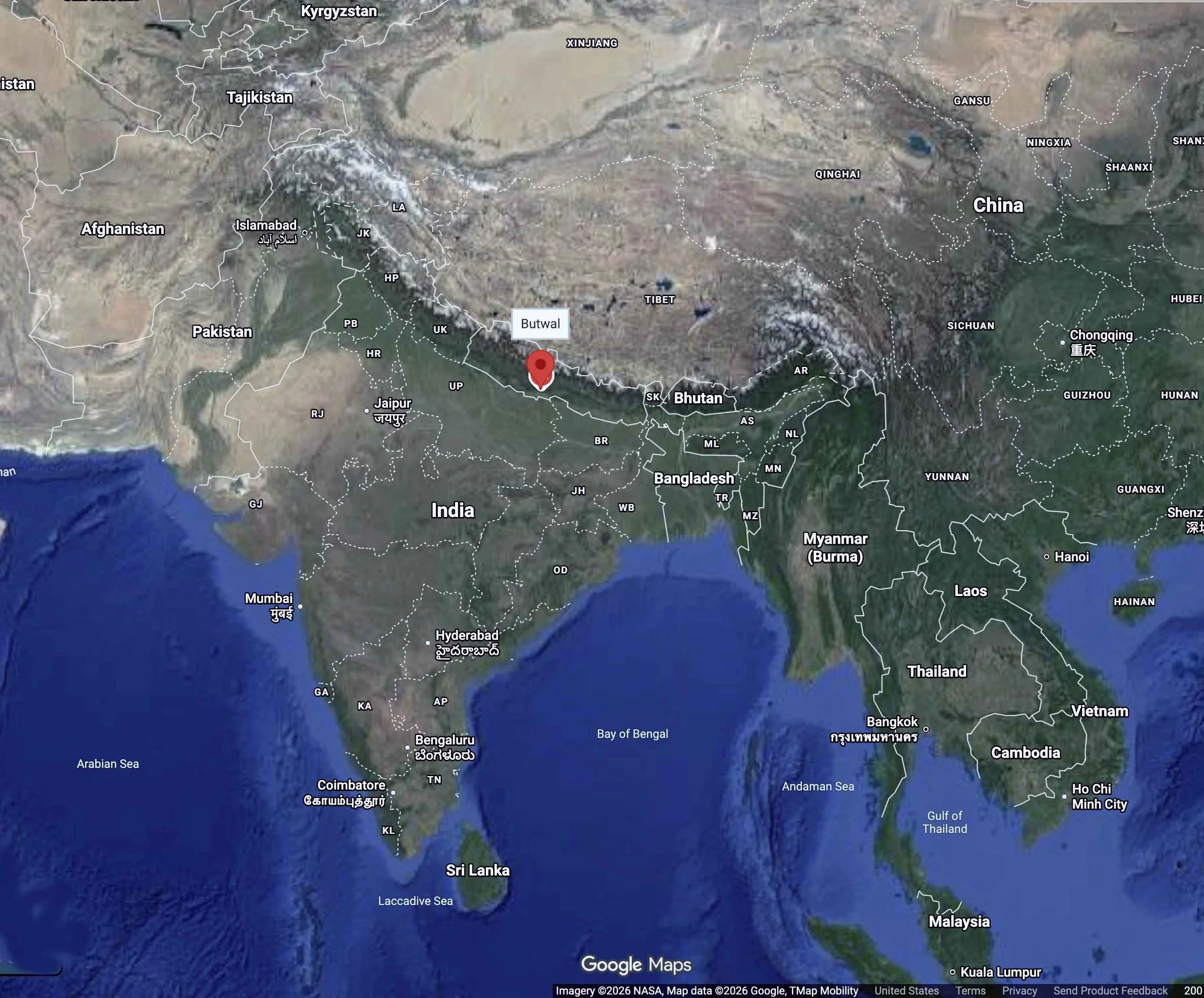
A standout success in this broader framework is the 18 km, 400 kV cross-border line connecting the New Butwal Substation to the Indian grid. With a transmission capacity exceeding 3,500 MW, this short but potent section serves as a vital cross-border artery and a stabilisation key for the industrial hubs of Butwal and Bhairahawa. Historically, the absence of this link created a frustrating paradox: domestic generators were forced to spill excess energy during monsoon months due to grid bottlenecks, while nearby industrial corridors suffered from frequent power instability. Recognising the strategic urgency, the MCA-Nepal Board made a decisive operational move to unbundle the 18 km cross-border segment from the larger 315 km package to fast-track its construction. That proactive decision paid off.
Source: Google Maps