Read the full article here.
Central Asia could unlock significant economic benefits from closer cooperation between its electricity systems, with a developed regional architecture potentially generating up to $640 million in annual gross benefits, according to a new report by the Eurasian Development Bank (EDB). However, the region’s ability to realize this potential will depend less on building new power lines alone than on addressing grid bottlenecks, improving operational coordination and establishing reliable rules for cross-border electricity trade.
The report, titled Energy Without Borders: The Architecture of Power Connectivity in Central Asia, prepared in cooperation with the United Nations Economic and Social Commission for Asia and the Pacific (ESCAP), notes that the region is not starting its energy integration from scratch. Yet what was designed for a different energy reality is increasingly struggling to accommodate rising demand, new renewable energy capacity and changing patterns of electricity consumption.
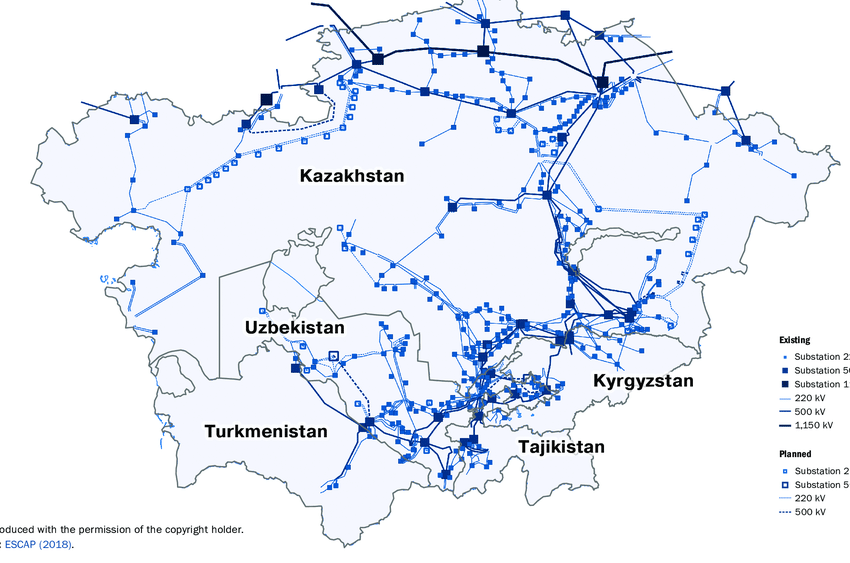
The report places southern Kazakhstan among the region’s major electricity load centers, highlighting its dependence on the North-South transmission corridor that connects it to the country’s northern power system. The electricity balance of southern Kazakhstan is covered roughly equally by domestic generation and electricity flows from northern Kazakhstan, meaning that the transmission corridor is not simply a route for regional electricity trade but an essential part of the country’s domestic energy security.
An emergency shutdown of the North-South line would deprive the southern regions of approximately 2,000 megawatts of power flows, significantly complicating the system’s ability to respond to an outage. At the same time, imbalances elsewhere in the Central Asian power system can place additional pressure on the corridor, increasing the risk of overloads.