

China’s AI just mapped its entire renewable energy grid. Here’s why the rest of the world should pay attention
Read the full article here.
A study published in Nature this week by researchers from Peking University and Alibaba Group’s DAMO Academy has produced something that no country has managed before: a complete, high-resolution, AI-generated inventory of an entire nation’s wind and solar infrastructure, with the analytical framework to coordinate it as a unified system.
Using a deep-learning model trained on sub-metre satellite imagery, the team identified China’s 319,972 solar photovoltaic facilities and 91,609 wind turbines, processing 7.56 terabytes of imagery to do so.
Prior research into solar-wind complementarity – the idea that two sources can offset each other’s variability in time and geography – has largely relied on hypothetical or modelled deployment scenarios. How complementarity manifests under real-world infrastructure, and how it shapes system-level integration outcomes, has until now remained unclear.
The researchers show that solar-wind complementarity substantially reduces generation variability, with effectiveness increasing as the geographic scope of pairing expands.
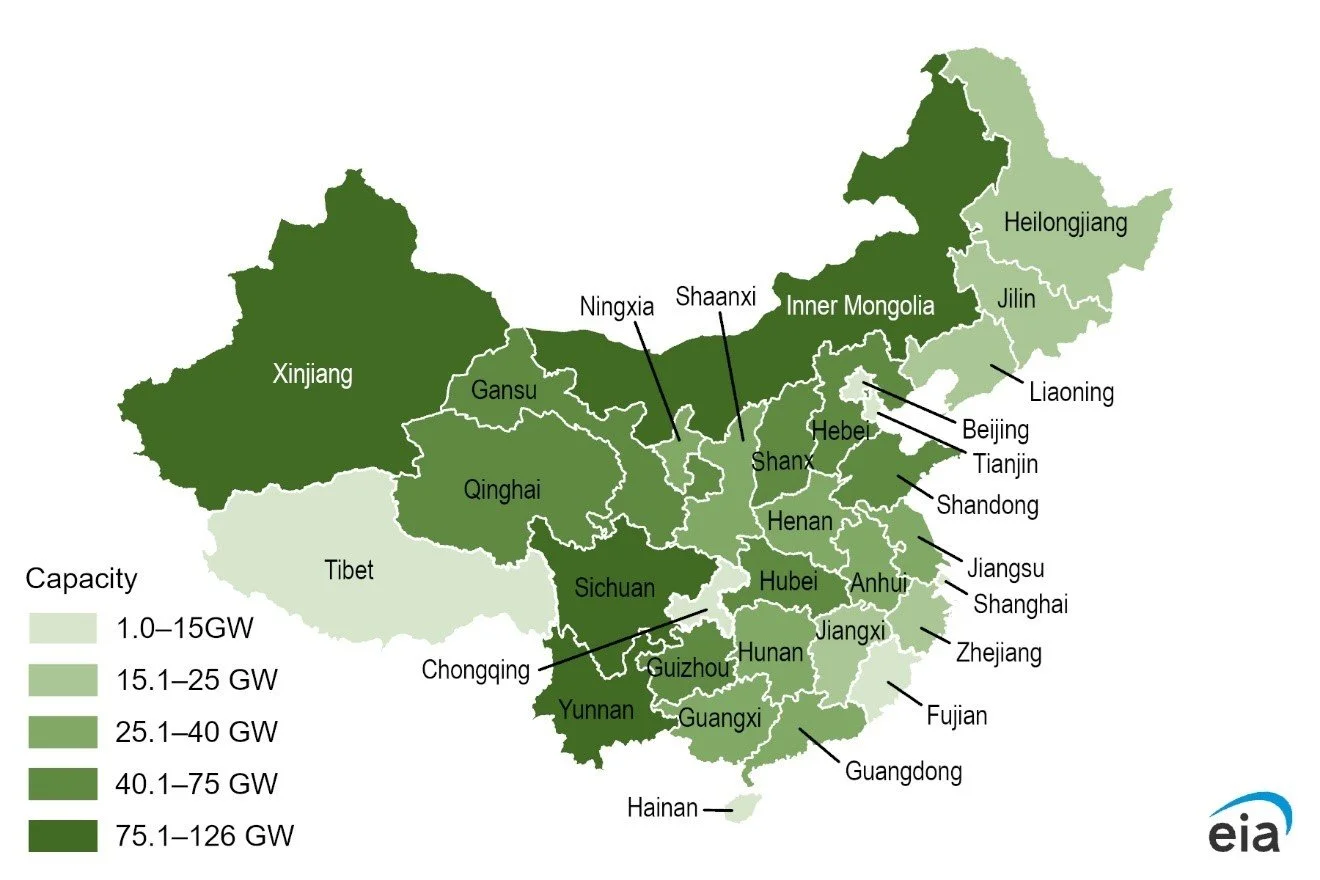
Data source: U.S. Energy Information Administration, World Bank, and Global Energy Monitor, Global Integrated Power Tracker, February 2025 release