

Energy Security Is Increasing The Value Of Cross-Border Electricity
Read the full story here.
Energy independence was an understandable slogan in Europe after Russia’s invasion of Ukraine sent gas and electricity prices through the roof. But it was also the wrong lesson. European countries had not erred by depending on one another. They had allowed too much of a critical energy supply to depend on one increasingly unreliable counterparty. The better objective is strategic energy interdependence: more trusted partners, more routes, more generation diversity and enough redundancy that losing one supplier or corridor is disruptive rather than destabilizing.
Four years later, the international HVDC pipeline provides a useful test. RTE International’s July 2026 inventory contains a substantial population of future voltage-source-converter projects, and filtering it for cross-national schemes produces about 60 prospective international links. Europe and its immediate neighbourhood dominate. If worsening geopolitics were pushing countries toward electrical autarky, cross-border transmission should be retreating. Instead, it remains a significant infrastructure category in the region where energy security has become most politically salient.
An electrical interconnector creates a different dependency from a fuel pipeline. A gas pipeline or LNG terminal delivers value only as long as fuel keeps arriving, leaving the importer continuously exposed to commodity prices, supplier behaviour and the fuel market. An interconnector joins power systems that already contain generation, storage, demand and other connections. Electricity can generally move in either direction. Multiple links can expose a country to hydro, wind, solar, nuclear, storage and dispatchable generation across different jurisdictions and weather systems without removing domestic resources from the portfolio.
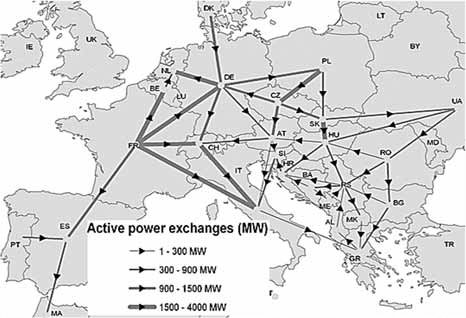
Source: Chankov, Georgi & Hinov, Nikolay. (2021). The energy strategy and energy policy of the European union.