

Phasing Out Coal Power Through Cross-Border Renewable Energy Trade in the Asia-Pacific
Read the full article here.
Coal remains the backbone of electricity generation in the Asia-Pacific region, accounting for half of total regional output and two-thirds of global coal-fired capacity. The substantial environmental and public-health externalities of coal highlight the urgent need to accelerate the renewable energy transition. Limited research has examined whether cross-border renewable energy trade could support a complete coal phase-out. This study provides a quantitative assessment of how electricity trade under the Regional Comprehensive Economic Partnership can replace coal while maintaining a firm electricity supply at competitive cost. The results show that regional renewable energy trade can supply electricity 24/7 at USD 70–89/MWh, comparable to coal power and substantially lower than natural gas or nuclear power. Under different cost scenarios, solar capacity ranges from 2518 GW to 2947 GW, while wind capacity ranges from 928 GW to 1178 GW. At the regional scale, renewable energy trade could displace the entire coal fleet and avoid about 7 Gt/year of CO2 emissions.
Phasing out coal-fired power is particularly urgent in the Asia-Pacific. Regional electricity trade could accelerate its replacement by sharing renewable energy resources across countries with different generation profiles. However, it remains unclear whether electricity trade can substitute for existing coal-fired power while maintaining a continuous electricity supply at competitive costs. To address this gap, this study develops a high-resolution modelling framework that quantitatively evaluates the capacity of renewable energy trading to support coal phase-out across the Asia-Pacific region. The modelling aims to provide new evidence to ongoing debates on coal phase-out strategies and highlight the key role that renewable energy trade can play in the regional energy transition.
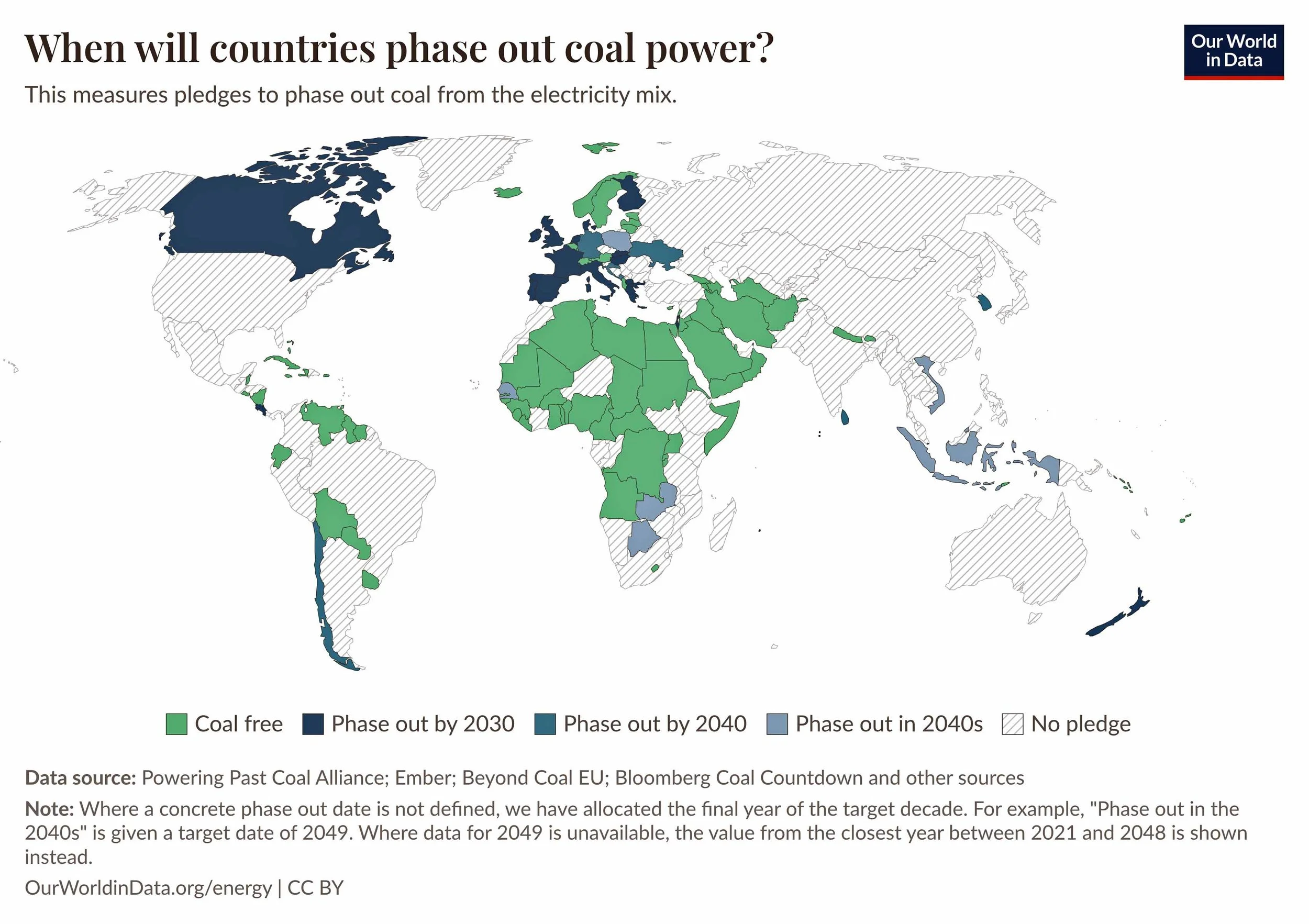
Source: Our World In Data