

Read the full article here.
The Mekong subregion could be an integral component of Southeast Asia’s response to greater energy market volatility, exposed by the 2026 Strait of Hormuz closure. Its substantial hydropower capacity, together with growing non-hydro renewables, could support greater regional energy resilience. But progress is constrained by fragmented grids, inconsistent standards, uneven energy mixes and transboundary environmental and water security concerns. Fully realising the Mekong’s potential will depend on deeper cross-border connectivity and greater complementarity between hydropower and non-hydro renewables across the subregion.
The transboundary challenge of reconciling energy ambitions with water security is compounded by the uneven power mix across the Mekong subregion. Wind and solar have expanded rapidly in some countries, particularly in Vietnam, while hydropower still supplies around three-quarters of Laos’s electricity. More significantly, these different energy resources are not yet matched by integrated grids, cross-border operating arrangements and common market rules. This limits the region’s ability to make full use of flexible hydropower, complemented with variable renewables across different seasons and locations.
The main constraint to regional power grid integration is institutional and operational fragmentation, while hydrological and topological differences add another layer of difficulty. These constraints point to two priorities for the Mekong — stronger cross-border connectivity and greater complementarity between hydropower and non-hydro renewables.
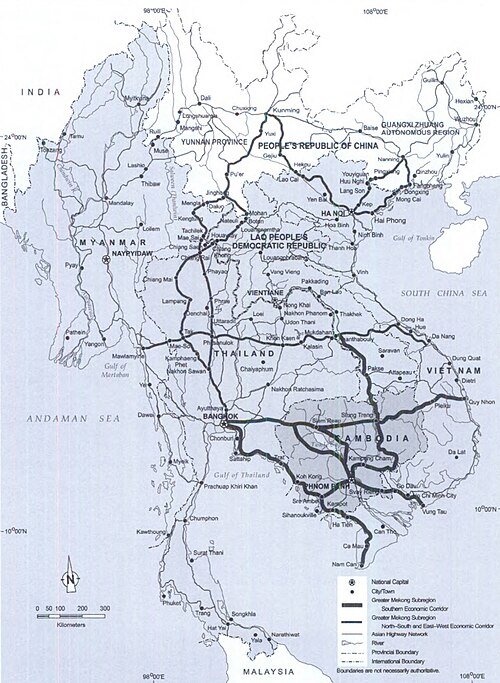
Source: Wikipedia