

Integrating the country's regional power grids
Read the full article here.
Last week, the Association of Southeast Asian Nations (ASEAN) Energy Business Forum (AEBF) was held at the Philippine International Convention Center (PICC) in Pasay City to discuss the 11-nation region’s evolving energy landscape. The forum was hosted by the Philippine Department of Energy (DOE) and organized by the ASEAN Centre for Energy (ACE) alongside the ASEAN Ministers of Energy Meeting (AMEM).
These regional grids are linked by transmission cables that were sized for occasional support, not for the level of daily dependence that the Visayas now requires. The Luzon-Visayas link dates back to 1998, while the Mindanao-Visayas interconnection project was completed in 2024 as the last piece needed to physically connect all three major island groups for the first time. But an interconnection is not the same as sufficient capacity.
Consider what that means in practice. Luzon currently carries a surplus of roughly 5,000 megawatts (MW)—which the region is not using at a given moment. If the Philippines truly operated one integrated grid, that surplus could meaningfully ease the shortage in the Visayas, where wholesale electricity prices during a recent billing period averaged ₱18.59 per kilowatt-hour (kWh), nearly four times the ₱4.80 recorded in Luzon over the same stretch.
Since the cable connecting the two grids can only carry a fraction of that surplus, the bottleneck is not a matter of willingness. It is a matter of physical capacity, built years ago for a different set of assumptions about how much power the Visayas would need to import, and how often.
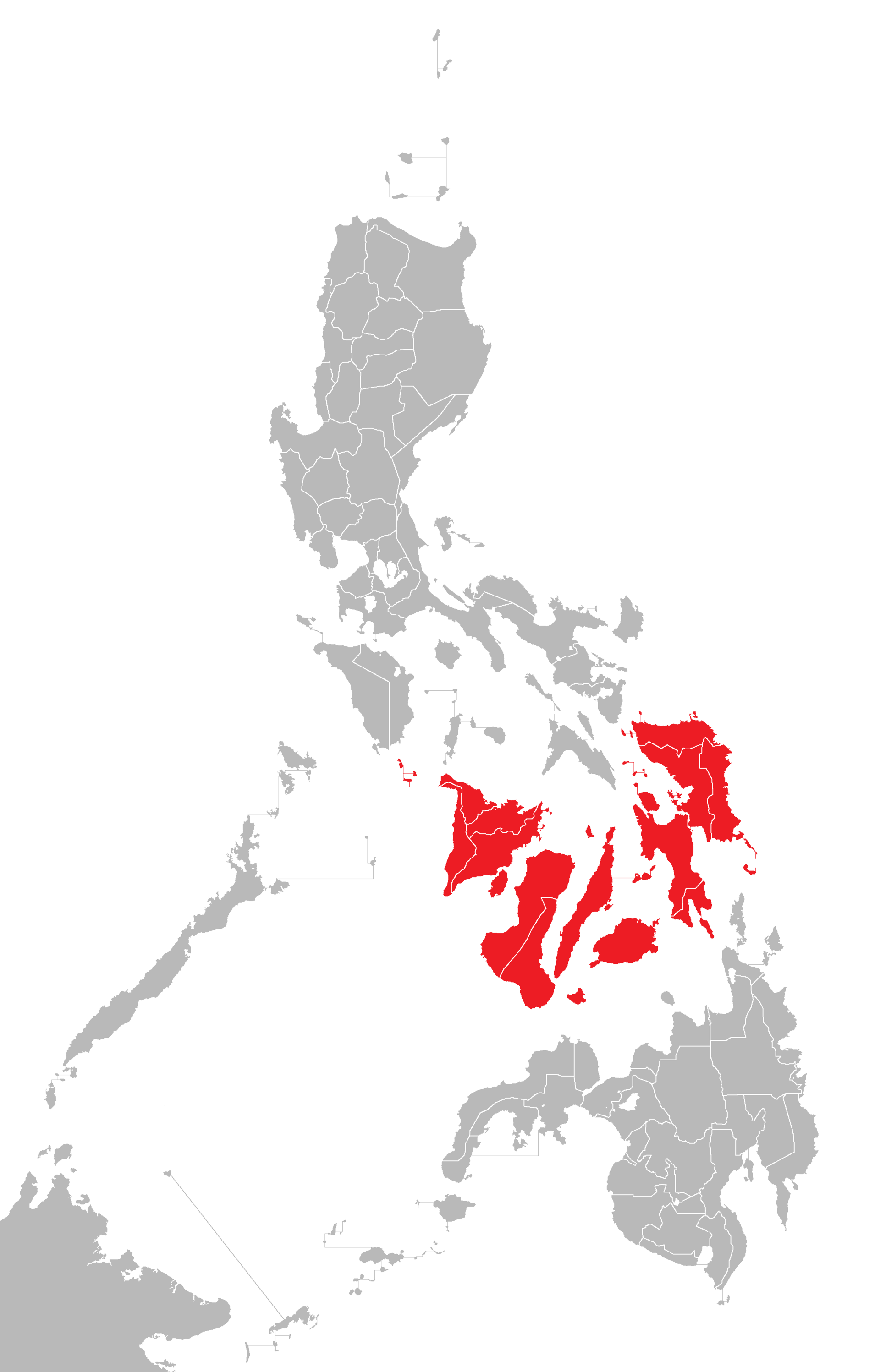
The Visayas within the Philippines. Source: Wikipedia