

Read the full article here.
Nepal’s transition from power importer to exporter shows how cross-border electricity trade can enhance energy security while deepening regional cooperation.
For decades, despite possessing enormous hydropower potential, more than half of Nepal’s peak electricity demand was often met through imports from India due to limited domestic generation capacity, inadequate transmission infrastructure, and insufficient investment in the power sector. Electricity shortages and prolonged load shedding were a persistent feature of Nepal, with power cuts extending up to 18 hours a day in several urban centres.
This narrative, however, has shifted significantly. Nepal has moved from a net importer to a net exporter of electricity, with the Nepal Electricity Authority (NEA) 2025 reporting that exports to India rose to 2,380 GWh, 22.3% higher than the previous year. This transition reflects that Nepal’s clean energy transition is becoming a story of grid diplomacy, not just domestic infrastructure.
Recent data illustrate the scale of Nepal’s transition. Nepal’s net export to India was 699 GWh in the year 2024–25, and imported energy from India made up only 12.13% of the total demand, which is 17.42% less than the previous year. This made Nepal a net electricity exporter.
Nepal’s electricity trade with India has historically been seasonal, with exports during the wet season and imports during the dry season when hydropower generation falls. Recent trends show that dry season import volumes have declined steadily as domestic installed capacity grew. This suggests a steady strengthening of Nepal’s domestic generation capacity. There have been significant gains in network efficiency and capacity expansion also. System losses also fell from 28.35% in 2011 to 12.26% in 2025, while transmission-specific losses reduced to 3.99% in 2025.
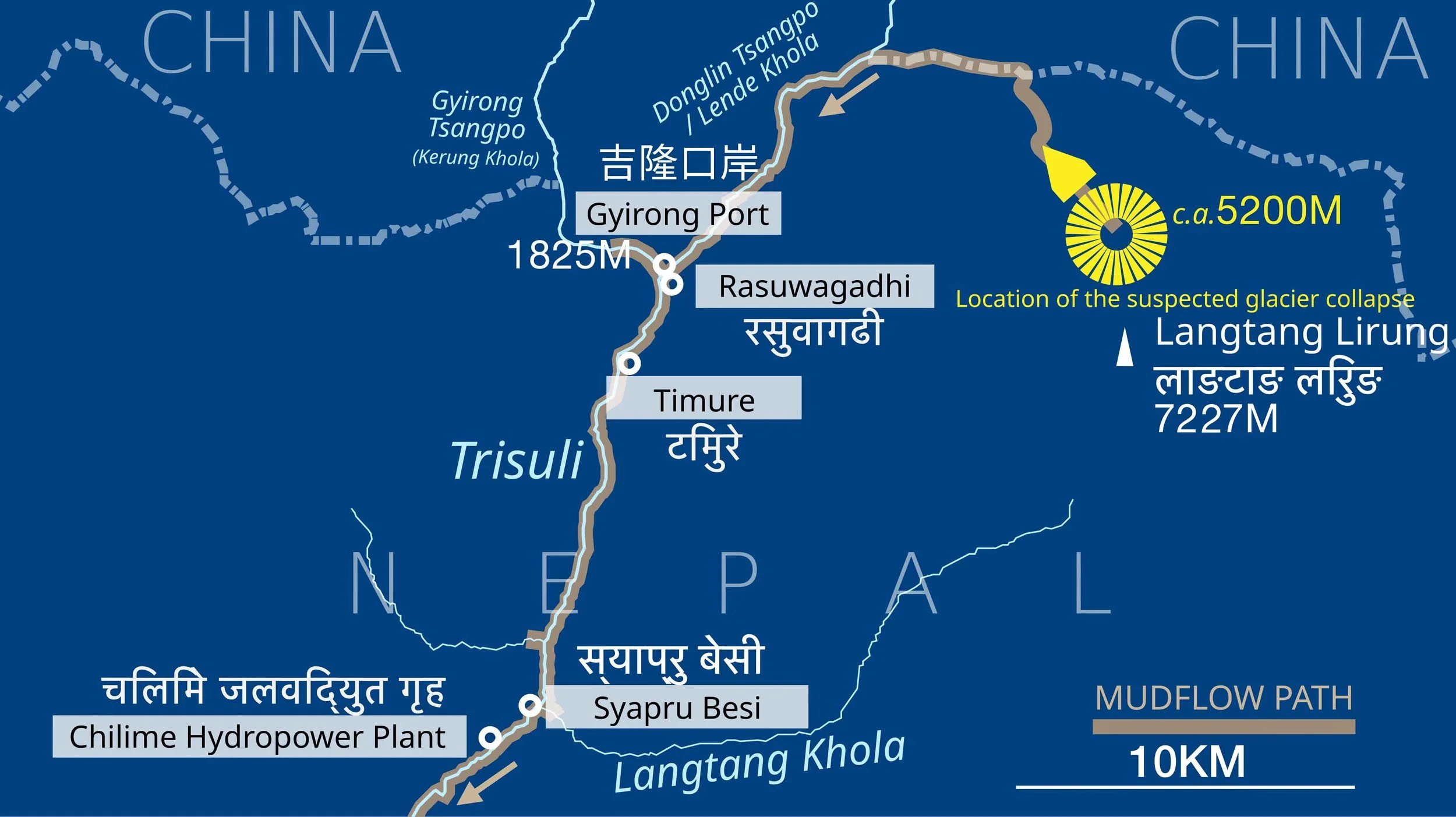
Suspected glacier collapse site, yellow arrow | Source: Wikipedia